
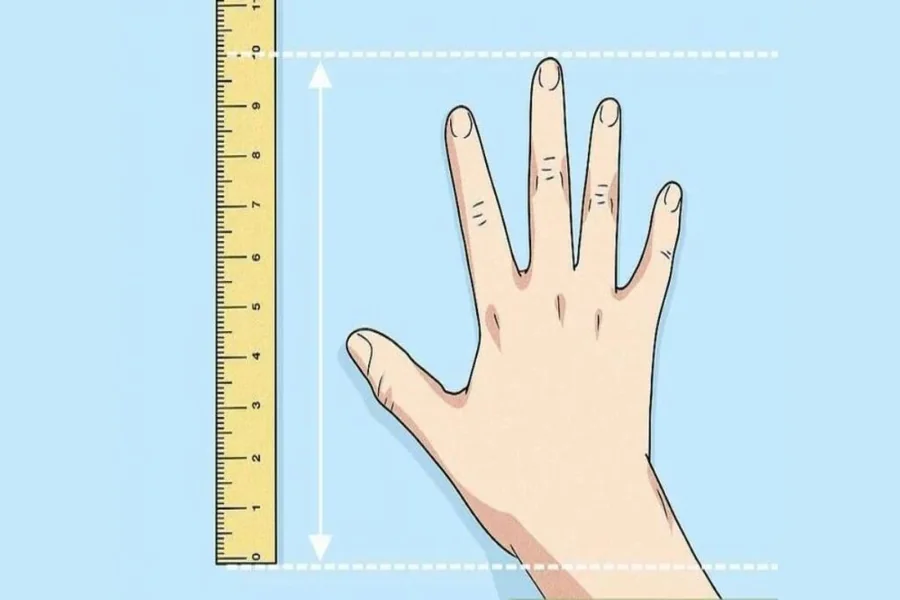
When one wonders What Does 10 Inches Look Like, they are typically attempting to picture a distance which might be abstract initially. Numbers do not necessarily provide a clear image, and thus a comparison to real-life objects may make the process of understanding numbers significantly easier.
The size of ten inches is a typical measure in everyday life, both in gadgets and household life to tools and school supplies. As soon as you associate it with the things that you know, it becomes quite easier to relate to it, and imagine it.
The Simple Rules of 10 Inches
First, one foot is of course 12 inches, and 10 inches is a little less than a foot. It implies that it is quite similar to the entire length of a ruler, albeit a little lesser.
When you hold a ruler in your hand 10 inches would be nearly the difference between the two extremes, and you would have just made the last two-inch marks. This in itself presents an expedient and visual point of reference.
One other way of thinking about it is hand. The length of the distance between the tip of the thumb and the tip of the pinky finger when extended is nearly 8 to 10 inches in the case of many adults, depending on the size of the hand.
Objects No Larger than 10 Inches Everyday
This length can be easily described by comparing it to things that you encounter in your daily life. A lot of ordinary items measure less than 10 inches.
To illustrate, an average tablet display is usually approximately 10 inches in the diagonal. This makes tablets an excellent reference to see that size.
The longer side of a sheet of paper such as A4 or letter size measures approximately 11 to 11.7 inches. Thus a height of 10 inches would be a bit less than the size of an average notebook page.
A large kitchen knife is another common analogy. Another handy reference is many chef knives that have a blade of between 8 to 10 inches.
Even those few bottles of water or small laptops are somewhere in this size range and will help you better visualize the size in your everyday setting.
Imagining 10 Inches with Tools
Even when you do not have a ruler there are easy tricks to determine 10 inches. The human body can serve as a crude calculator.
An example is that the average adult hand length between the wrist and fingertips is typically between 7 and 8 inches. A few more inches in the mind brings you to 10.
Finger widths will also work. Most people have a width of one finger of about 0.7 to 1 inch. Approximately 10 finger widths can provide an approximate estimate.
The other is with your forearm. To others half the length of the forearm is almost 10 inches, but again this differs amongst individuals.
These are not precise methods, and yet of use when you require an approximation in a hurry.
Why It is Important to Study Measurements
It is more helpful to know what 10 inches look like than it may seem on the surface. Most of the daily choices involve measurements.
Product dimensions are commonly described in inches when shopping on the Internet. When you can imagine the measurements, then you are less likely to come up with either something that is too large or too small.
It also aids in house improvement projects, furniture placement, or even the selection of the correct size of bag or even device. The ability to visualize measurements is time-saving and error-preventing.
Spatial awareness and applied mathematics are enhanced in the educational process, particularly among learners, through the knowledge of sizes.
Typical Size Fallacies
When people use numbers as the only measure, they tend to make mistakes in judging lengths. Ten inches may be too small or too big depending on the situation.
In one instance, a person may think that 10 inches is a lot longer than it is without having a reference of its length. Conversely, it can be underestimated by other people who are accustomed to the use of metric measurement such as centimeters.
The other source of confusion is the difference between the length and diagonal measurements. A 10 inch screen, say, is diagonally, as opposed to straight, which in our case makes it appear larger than anticipated.
All these details can assist in preventing any confusion and create a more realistic sense of scale.
10 Inches to Other Units
To those who may be more at ease with metric units, it may be easier to convert inches. Ten inches translates to about 25.4 centimeters.
It is slightly more than 25 cm or approximately the length of a standard school ruler in most countries.
Ten inches approximately equals 0.83 feet in feet. Although, this is not as intuitive, it supports the notion that it is slightly less than a full foot.
The conversions can be particularly useful to know when working with international measurements or product specifications.
Final Thought
It is quite easy to understand What Does 10 Inches Look Like after relating it to real-world objects and easy comparisons. Can be a piece of paper, tablet, or in the span of your hand, these references make an abstract number a reality.
Rather than making guesses, a general guide of the items you use on a daily basis can assist in the construction of a practical sense of measurement. This allows one to estimate sizes in the long run without necessarily having to use a ruler.
FAQs
What does 10 inches look like compared to a ruler?
It is slightly shorter than a standard 12-inch ruler, missing about 2 inches from the full length.
Is 10 inches close to a foot?
Yes, it is just 2 inches less than a full foot.
What common object is 10 inches long?
A tablet screen or a large kitchen knife is often around 10 inches in length.
How many centimeters is 10 inches?
Ten inches is approximately 25.4 centimeters.
Can I estimate 10 inches using my hand?
Yes, combining your hand length and finger span can give a rough estimate close to 10 inches.
Why do people misjudge 10 inches?
Because numbers alone are hard to visualize without real-world comparisons.
Is 10 inches considered large?
It depends on the context, but in general measurement terms, it is a moderate and practical length.
